

YouTube
Your fitness watch provides quite a bit of data. Heart rate, sleep, steps, recovery, VO2 max, and more are all right there on your wrist.
But once you have all that information, you may find yourself wondering,
“Okay…what am I actually supposed to do with this?”
Fitness wearables can provide valuable insight into how your body is responding to training, stress, sleep, and recovery. But more data doesn't always mean better decisions. The key is knowing which metrics matter, what they can tell you, and how to put them into context.
At Kathletics, we preach meeting you where you are in your fitness so you can approach hybrid training in a sustainable way. That means using the tools available to you without letting a number on your watch dictate how you feel or how you train.
Before we dive into the data, there’s one important rule:
Before you look at your sleep score, heart rate variability, or recovery score, ask yourself how you feel.
Do you feel rested?
Are you feeling fatigued?
Are you unusually sore?
Do you feel ready to train?
Are you feeling run-down or like you might be getting sick?
Your fitness watch isn't going to be 100% accurate. The data can be helpful, but it should be used as one piece of the puzzle, not the entire picture.
Your subjective experience matters.
With that in mind, here are five fitness watch metrics I recommend paying attention to when it comes to training and recovery.
Heart rate variability, or HRV, measures the variation in time between your heartbeats.
While there are a lot of nuances to HRV, one of the most useful ways to use this metric is to understand your personal baseline.
If you're new to wearing a fitness watch, don't expect it to immediately know what "normal" looks like for you. Give it some time to collect data. Ideally, wear your device consistently for more than a week so you can start to establish a baseline.
In general, a higher HRV can indicate that your body is better able to respond to stress, while a lower HRV can occur when your body is under more stress.
A decrease in HRV can be associated with things like:
However, your baseline is what matters most.
If your HRV is consistently on the lower end, that may simply be normal for you. The same goes for someone whose baseline tends to be higher. What becomes more interesting is when you notice a significant change from your normal.
For example, maybe you wake up one morning and think, "I really don't feel great today."
Then you follow up that thought by checking your HRV and notice that it also dropped significantly overnight.
That doesn't necessarily mean your watch has diagnosed a problem. Instead, it can provide some additional validation that your body may be experiencing more stress than usual.
Don't make a training decision based solely on your HRV. Look at it alongside how you feel, your sleep, your training load, and everything else going on in your life.
Your resting heart rate is another metric that can give you insight into how your body is responding to stress and recovery.
Similarly to HRV, the most useful thing you can do is establish your personal baseline. Track your resting heart rate over time and pay attention to how it changes based on factors such as:
You may notice that your resting heart rate increases during periods of higher stress or when you're not recovering well.
Alcohol can also have a noticeable impact on your recovery. Even one drink can potentially affect your HRV, resting heart rate, sleep, and overall ability to recover. That doesn't mean you need to make drastic changes every time your resting heart rate shifts, but do look for patterns and significant deviations from your normal.
If your resting heart rate suddenly looks very different than it typically does, that's worth paying attention to—especially if you're also feeling fatigued, run-down, or unwell. Again, your resting heart rate is simply another piece of the puzzle.
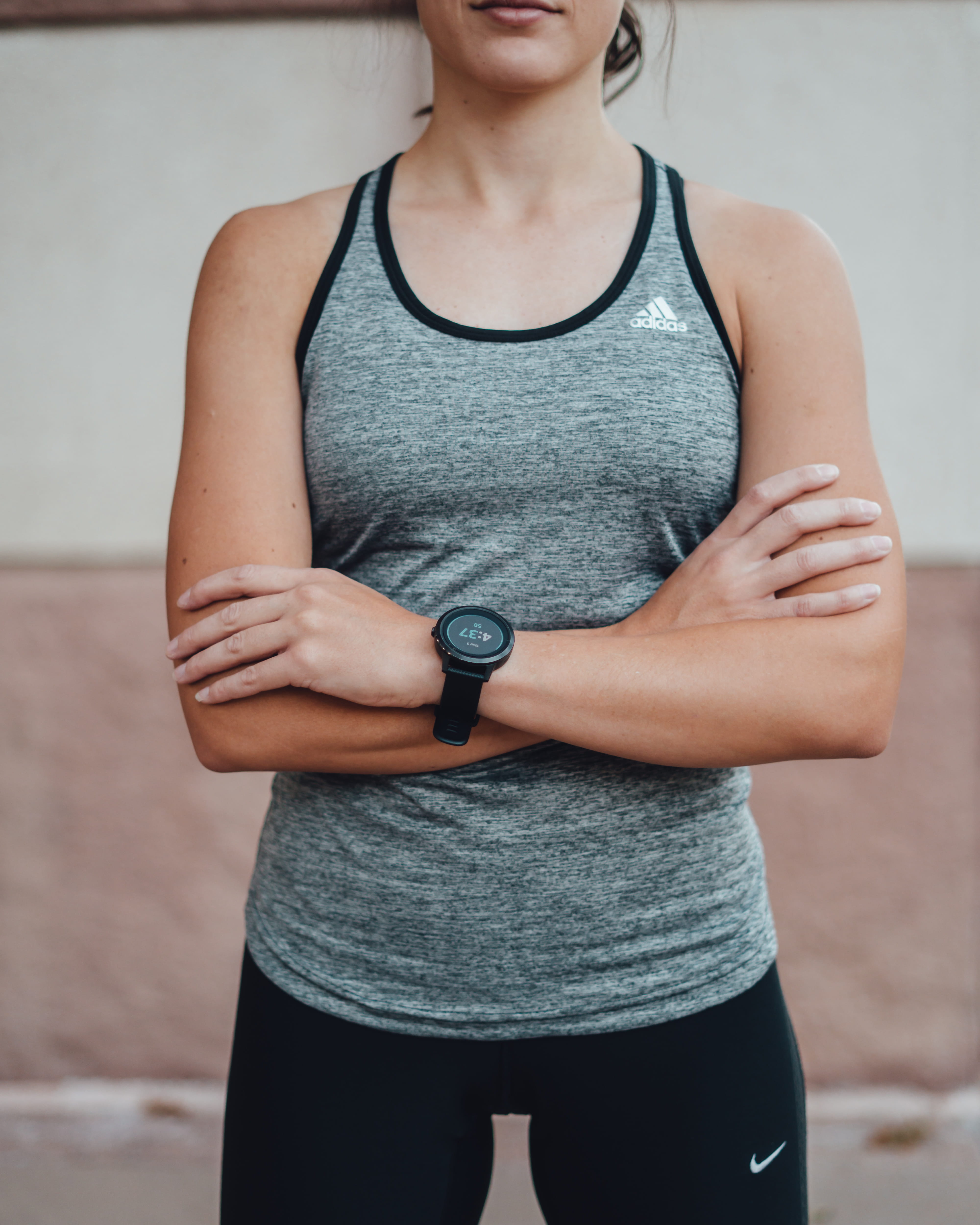
Step count is one of the simplest metrics your fitness watch provides, but that doesn't mean it's insignificant. In fact, your step count can be a really useful tool for identifying opportunities to increase your daily movement.
For many people, getting more steps in throughout the day can be a more accessible way to improve overall activity levels without adding another formal workout. 8,000-10,000 steps per day is a good long-term goal.
If you're currently averaging around 2,000 steps per day, going straight to 10,000 may be a huge increase in your activity. Instead, start small. Try increasing your daily average by approximately 500-1,000 steps, then gradually build from there.
Your sleep data can provide another useful look at your recovery.
Your fitness watch may give you an overall sleep score and break your sleep down into different stages, including:
You may also notice that your sleep data corresponds with what you're seeing in your HRV and resting heart rate.
But once again, start with how you feel.
When you wake up, ask yourself:
"Do I feel rested?"
"Do I feel like I got enough sleep?"
"Do I feel ready to take on the day?"
Then look at your watch.
Maybe you wake up feeling fantastic, only to see that your watch gave you a sleep score of 70. Does that mean you actually had a terrible night of sleep? Not necessarily.
On the flip side, you might wake up feeling exhausted, check your watch, and see a sleep score of 92. Your response might be, "hmm, I think not." And that's okay. Sleep trackers aren't perfect.
Use the data to identify patterns, rather than obsessing over one night's score.

Finally, let's talk about VO2 max.
VO2 max is a measure of your body's ability to use oxygen during exercise and is commonly used as an indicator of cardiovascular fitness. The most accurate way to measure VO2 max is through a laboratory test, but that's not practical nor necessary for most people.
So, can you completely trust the VO2 max number on your fitness watch? Probably not. But that doesn't mean it's useless. Your watch's VO2 max estimate can provide a starting point for understanding your cardiovascular fitness.
If your watch consistently estimates your VO2 max around the same level, you can use that information as a benchmark and look at how it changes over time.
Many watches will also categorize your VO2 max as something like poor, fair, good, or excellent, giving you a general idea of where you fall.
Rather than getting caught up in whether the exact number is perfectly accurate, look at the bigger picture.
Are you training consistently?
Is your cardiovascular fitness improving?
Are your runs feeling easier?
Can you maintain a faster pace at the same effort?
Those things can all provide useful information about your cardiovascular fitness.
Fitness watches are incredibly useful tools, but they should support your training—not control it.
The goal isn't to chase a perfect sleep score, HRV number, or recovery score. The goal is to use the information available to you to make better-informed decisions about your training and recovery.
Start by learning your baseline.
Look for trends rather than individual numbers.
Pay attention to significant changes.
And most importantly, ask yourself how you feel before you look at the data.
When you combine objective data from your fitness watch with subjective feedback from your body, you can get a much clearer picture of how you're responding to your training.
.png)
Katharine Moustakes is the founder, personal trainer, and running coach of Kathletics. She coaches runners, hikers, and outdoor enthusiasts to build strength and endurance that can be sustained all year long. Through the Kathletics blog, she shares practical advice to help athletes train smarter, stay consistent, and achieve their goals.
Get strength and endurance tips, running recs, and all the Kathletics updates right to your inbox.
